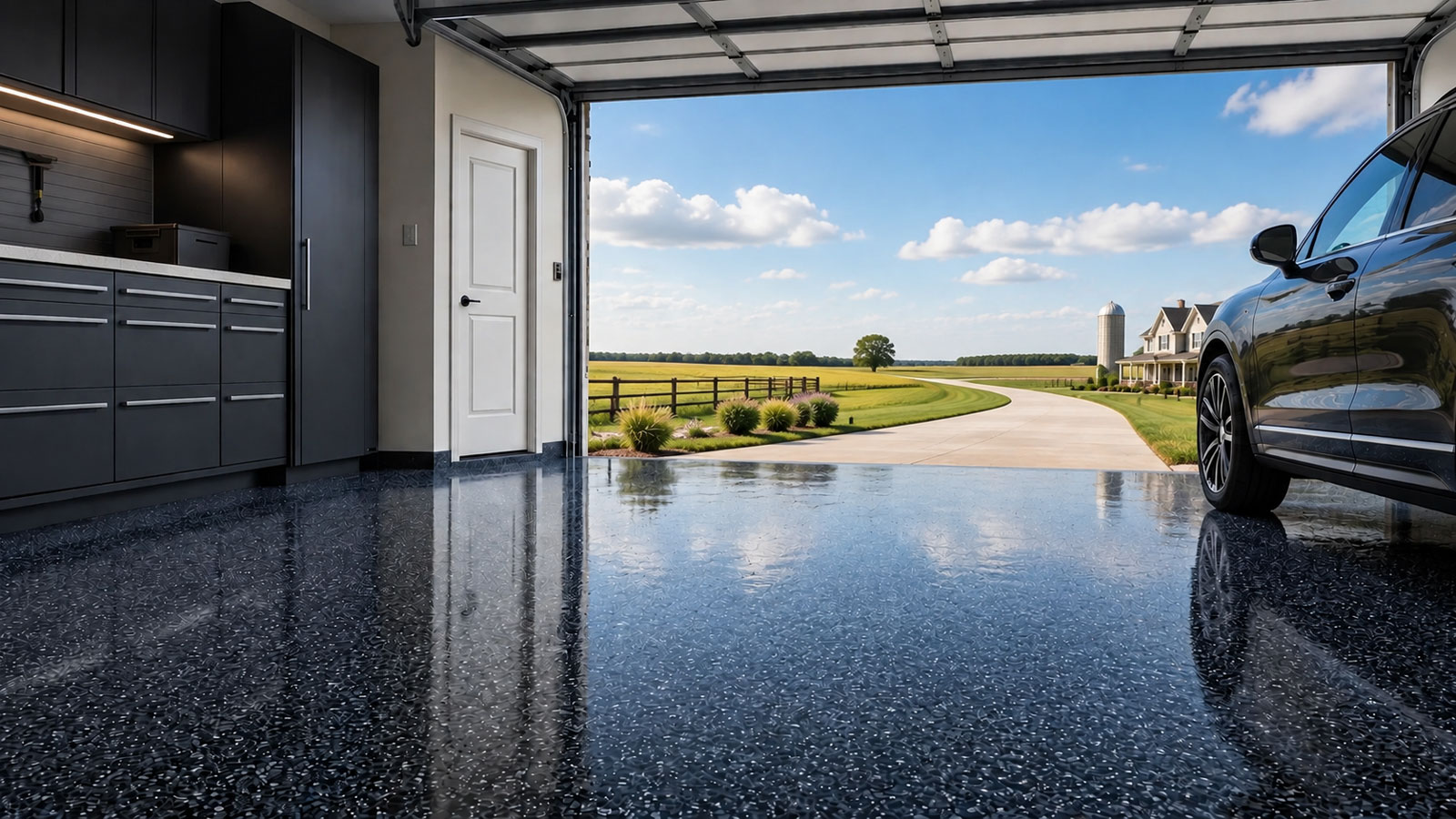
Garage Floor Coating in Overland Park, KS
Floor Coating Services in Overland Park, KS
Overland Park is a postwar suburban city on a very large scale. It incorporated in 1960 with 28,085 residents and now covers about 75.6 square miles with more than 200,000 people. That growth produced everything from early suburban ranch homes to much newer southern subdivisions and multi-bay garages. Older northern properties may have old paint and repairs, while modern southern floors may still have builder sealers or smooth finishes requiring grinding.
Drainage also varies widely. About 7 percent of the city's land was identified within the 100-year floodplain in a countywide mapping update, with much of that area concentrated in the Indian Creek, Blue River, and Tomahawk Creek basins. Floodplain maps do not prove slab dampness. Threshold water, driveway grade and a failed earlier coating are more useful in planning work for a specific garage.
For a garage-floor project, that means house age, slab age, and water history should be kept separate. A northern garage may have decades of paint and repairs; a newer southern floor may have curing compounds or sealers; a creek-adjacent property may add threshold or drainage questions.
Local Market Insight
Overland Park's expansion from a 1960 suburb into a 75-square-mile city creates a pronounced north-to-south range in garage age, while Indian Creek, Blue River, and Tomahawk Creek drainage makes water exposure property-specific.
What Affects the Cost of Garage Floor Coating in Overland Park?
Overland Park spans many residential construction eras. Earlier paint, patched concrete, new construction sealers and control joints can each alter the preparation scope. The Indian Creek, Blue River and Tomahawk Creek drainage basins add property-level runoff questions, while multi-bay garages can add significant edge and step detail.
Older northern-suburb floor history
Earlier Overland Park homes may have decades of paint, patching, oil staining, or prior coatings to remove. Old paint and repours on established lots can change removal work even when the slab remains structurally sound.
Newer southern subdivision slabs
Younger concrete may need fewer repairs but still requires profiling and removal of curing compounds or sealers. Builder sealers and dense troweled finishes need evaluation before selecting the mechanical surface profile.
Indian Creek, Blue River, and Tomahawk Creek drainage
Properties near floodplain corridors should be checked for actual water history rather than broad assumptions. Ask whether driveway runoff crosses the threshold or moisture remains in concrete after storms, not just about map location.
Control joints and cracks
Modern subdivision garages often have control joints and shrinkage cracks that should be evaluated before coating. Determine which joints should be treated and whether cracking shows active movement rather than assuming all are cosmetic.
Three-car and extended layouts
Larger garages, steps, utility alcoves, stem walls, and cabinets add material and edge work. Cabinetry, steps and extended bays can require detailed edge work not captured by the main rectangular floor measurement.
Sun, traction, and return-to-service
Door orientation, wet-weather use, decorative flake, and cure time all influence system choice. Direct sun at the open door and wet shoes can affect topcoat and traction preferences for daily use.
Call for a clear, project-specific estimate — or request one online.
Local Garage-Floor Conditions in Overland Park
In northern Overland Park, look for paint, repairs, and evidence that the garage floor was resurfaced or coated during prior renovations.
In southern growth areas, ask whether the slab was sealed or treated during construction. A clean modern floor can still require aggressive mechanical preparation.
If a property is close to Indian Creek, Tomahawk Creek, or the Blue River system, describe what actually happens during major storms. Floodplain context is useful only when connected to the specific driveway and slab.
Overland Park's 1960-to-today growth created several generations of garage concrete
The city grew from 28,085 residents at incorporation in 1960 to more than 200,000 today. As development moved south, garage sizes, slab ages, and subdivision construction practices changed with it.
An older north-city floor may require removal of decades-old paint or patch compounds. A newer south-city floor may mainly need sealer removal and a consistent mechanical profile.
The right preparation follows the slab, not the neighborhood's reputation.
The north-to-south age range can change the estimate materially. An early suburban floor may need old paint, patch material, oil staining, or a previous coating removed before profiling. A newer southern slab may need fewer repairs but can still carry a curing compound, sealer, or builder patching that prevents reliable adhesion. The useful question is not whether the house is “old” or “new,” but what is actually bonded to the concrete and whether the slab is one continuous pour.
Three major drainage basins account for much of Overland Park's floodplain
Indian Creek, the Blue River, and Tomahawk Creek contain much of the mapped 100-year floodplain within Overland Park. The city has long considered both current and future development when evaluating flood elevations.
For a homeowner, the practical check is at the garage door: does the driveway hold water, does runoff cross the threshold, or do any areas of the floor stay damp after storms?
If the garage stays dry, a nearby floodplain may have little bearing on coating selection. If water repeatedly enters, solve that first.
Floodplain mapping has identified roughly 3,422 acres—about 7.1 percent of the city—in the 100-year floodplain, with more than 70 percent of that acreage concentrated in the Indian Creek, Blue River, and Tomahawk Creek basins. That does not make every nearby garage a moisture problem. It does make actual water history worth asking about: threshold entry, low driveway grades, slow-drying slab edges, and failed coatings should be addressed before a decorative system is treated as the final fix.
Before coating an Overland Park garage
- Is the property in an older northern neighborhood or newer southern development?
- Is the slab painted, sealed, or previously coated?
- Are control joints, cracks, or patches present?
- Is the property near Indian Creek, Tomahawk Creek, or the Blue River?
- Does the driveway send water toward the garage?
- Is the garage two-car, three-car, tandem, or storage-extended?
- How much direct sun reaches the floor near the door?
Overland Park Garage Floor Coating FAQs
Are newer south Overland Park garages easier to coat?
They may need less repair, but modern slabs still require mechanical preparation and any curing compound or sealer must be addressed. A newer south-side garage may also contain curing products or dense troweled finishes.
Does floodplain proximity mean a garage cannot be coated?
No. The relevant issue is the actual slab and water history. Active water entry should be corrected, while a dry garage may be straightforward. Check whether the driveway sheds water away from the door and whether damp spots persist.
Can an older painted garage floor be recoated?
Often, after the old material is evaluated and weak or incompatible layers are removed so the new system bonds to sound concrete.
Why do three-car garages cost more than simple square footage suggests?
They often add stem walls, steps, cabinets, bay transitions, joints, and extra edge work as well as more floor area.
Should a sun-exposed Overland Park garage doorway influence finish selection?
It can. Direct sun at the open garage door may affect preferred topcoat properties and color stability, while the rest of the garage remains shaded. Compare the entire system alongside slab condition, traction, preparation and vehicle return time.
Overland Park Neighborhoods & Local Context
Phone Quote Line
Speak with a floor coating specialist about your project and get a realistic estimate range.
(913) 808-3039Typical Project Cost
$3,000–$5,500
Typical range for a two-car garage. Final pricing depends on floor size, concrete condition, prep work, coating type, and finish options.
Helpful Guides
Other Service Areas